
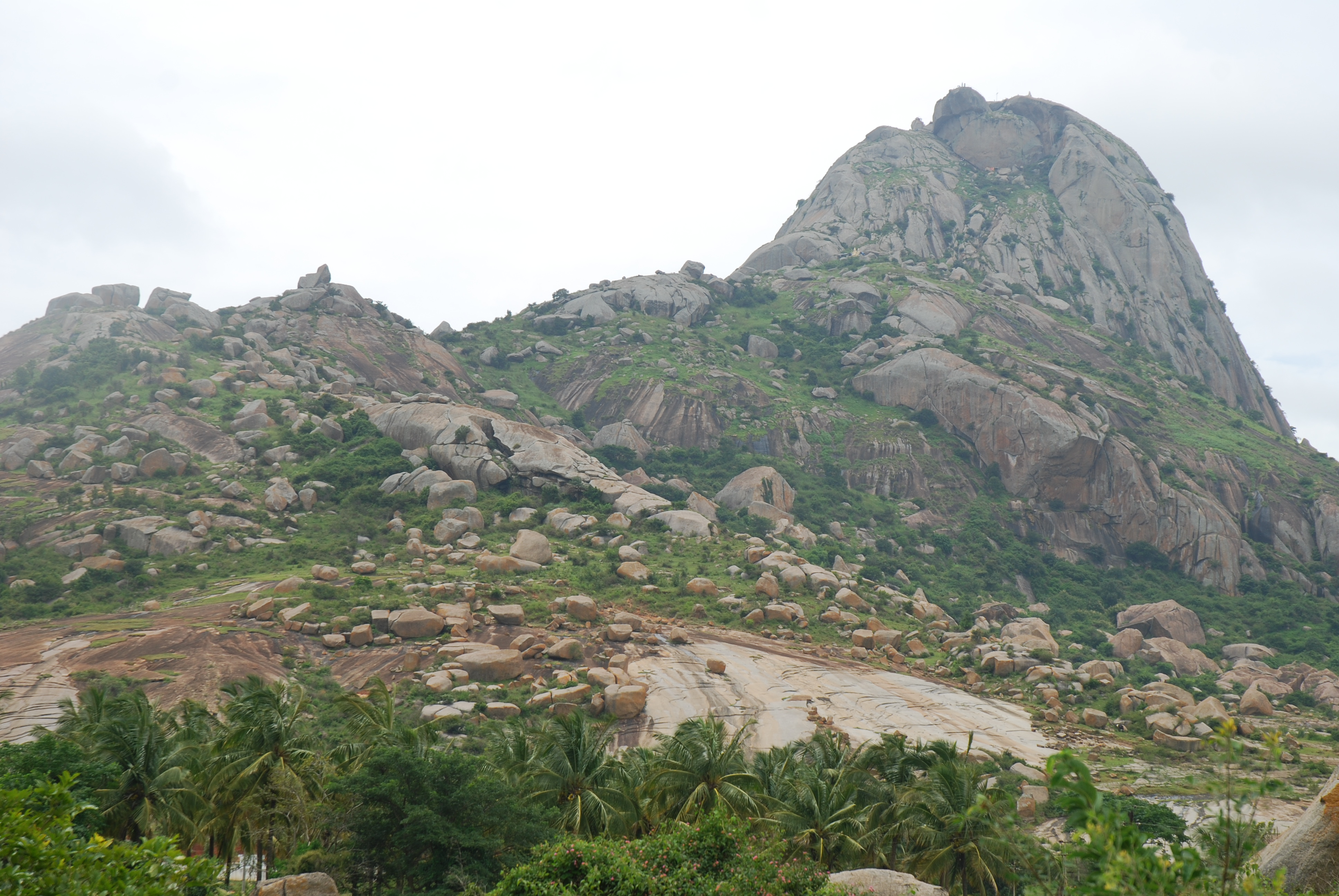

The Indian subcontinent is part of the Gondwana supercontinent and is nowadays attached to the northern supercontinent Laurasia. Geologically, India is very diverse including various types of igneous, metamorphic and sedimentary rocks. Attention for rock outcrops in this country dates back thousands of years and has deep religious and mythological roots. Testimonies to this are numerous monuments and temples directly built on rock outcrops which today are still worshiped by immense crowds of visitors. Among rock outcrops in India, inselbergs and lateritic plateaus form widespread landscape elements. Despite their occurrence in huge numbers in most parts of the country and their immense cultural and religious importance not much is known about their floristic inventory. Although local floras often note the presence of rare species on rock outcrops, comprehensive studies of these habitats are virtually non existent. In contrast, their geomorphology and geology has been thoroughly studied in the context of the exploitation of minerals and mining activities. In addition, such studies have been important for the understanding of landforms. A famous example is the central Indian landscape for which the term Gondwana was invented (after a tribe inhabiting central India).
Many parts of the peninsular India are composed of ancient crystalline basement rocks, predominantly of granite and gneiss. The geomorphological spectrum of granitic and gneissic inselbergs is impressive and includes large monoliths, shield-like outcrops and bolder strewn koppjes. Monolithic outcrops are typical for humid regions (e.g. Kerala), in contrast to koppjes which dominate vast stretches in the drier parts of India (e.g. in Andra Pradesh). Due to the widespread occurrence of granitic and gneissic outcrops India has one of the world’s largest quarrying industries and is one of the most important suppliers of rocks for constructions. For instance, the spectrum of different coloured granites is breathtaking and is expressed by names such as “Black Granite”, “Chilly Red” or “Magadi Pink”.
Rocky plateaus


Prominent flat topped hills of the Western Ghats have two types of natural rocky plateaus. Basalt plateaus are large expanses of igneous basalt that are exposed due to weathering processes. In some places basalt has weathered to metamorphic laterite under extremely seasonal paleoclimatic conditions which had hardened to form thick crust on the parent basalt. Such lateritic plateaus are known as ferricretes and occur on Western Ghats hill tops and on coastal plains of the Konkan-Malabar region. A few lateritic plateaus also occur in the drier parts of the Deccan plateau, which are proof of the past wet climate of the region. Laterite is in great demand as decorative stone for buildings. The aluminium mineral “bauxite” also occurs under the lateritic crust in some places. Hence lateritic plateaus are heavily quarried or mined throughout western India.
Vegetation of inselbergs


All types of Indian inselbergs have been severely disturbed by human activities, often dating back a long time. Today, grazing and quarrying pose the greatest threats, and in many cases the original vegetation cover has been converted into wasteland. It is therefore difficult to obtain an accurate picture of the structure and composition of inselberg vegetation, a task made even more difficult by the lack of published data. As elsewhere, exposed rock faces are covered by a biofilm of cyanobacteria, fungi and lichens. However, no data on their detailed composition are available, apart from a study on cyanobacteria from stony temple surfaces, which provides some clues about the biofilm communities on natural rock (Adhikary & Satapathy 1996) . Our own observations show that rocks on island mountains in humid regions are mainly covered by cyanobacteria, while lichens dominate in drier areas. Physiognomically, the vegetation of Indian island mountains resembles that of other tropical regions. However, there is one major difference: the monocotyledonous mats of desiccation-tolerant vascular plants, which are typical of African and South American inselbergs, seem to play a lesser role here (only sparse information is available for many parts of the country). Recent observations have shown, however, that the grass genus Tripogon forms mats on island mountains in the vicinity of Bengaluru. Other resurrection plants are also present. Ferns of the genera Actiniopteris and Selaginella are widespread. These ferns occur mainly in small rock crevices and on rocky slopes in open locations, where various Selaginella species form mats. Succulents are well adapted to severe drought and can also be found on Indian inselbergs. The most significant species here belong to the genus Euphorbia, and certain Apocynaceae, such as Caralluma (e.g. C. umbellata) and Sarcostema, can also be found.
Vegetation of rocky plateaus
Basaltic as well as lateritic plateaus are covered by cryptogamic crusts mainly made up of cyanobacteria and lichens. Cushions of mosses grow in crevices and offer growing sites for lithophytic orchids like Bulbophyllum, Eria and Porpax. Seasonal rock pools of various sizes and depths occur. Hydrophytes of Lythraceae (Rotala), Aponogetonaceae (Aponogeton saterensis, A. natans, A. bruggenii), Scrophulariaceae (Dopatrium), Linderniaceae (Lindernia) and Marsileaceae (Marsilea) are commonly observed. Ephemeral flush vegetation is a dominant community on plateaus during the monsoons. A great diversity of Utricularia and Eriocaulon species are widespread along with Smithia, Impatiens, Exacum and Hedyotis. Particularly remarkable is the presence of Trithuria konkanensis which belongs to a family (Trithuriaceae) that is otherwise only known from Australia. Species of EFV are mostly insect pollinated and bloom in the late monsoons (September). This is a mass flowering event that attracts diversity of pollinators and increases chances of successful pollination.
Desiccation-tolerant species of Tripogon and Cheilanthes are common on rocky plateaus, but there is as yet no documentation of mat-forming communities. These species also occur on cliffs in the region, and there appear to be close links between the outcrops, perhaps due to physical proximity. Most of the rocky plateaus have steep cliff edges. Geophytes are common in the deeper soil covered areas. Most common geophytes are Dipcadi (D. montana, D. concanensis), Chlorophytum, Crinum and acaulous Euphorbia. Grasses form a dominant community on the rocky plateaus immediately after the monsoons. Diversification in Glyphochloa, Ischaemum, Eulalia and Dimeria has led to the formation of several narrow endemics on the plateaus.
The seasonal wetland like conditions on rocky plateaus during the monsoon are ideal for providing habitats for herpetofauna. Narrowly endemic species of amphibians (Bufo koynensis, Xanthophryne tigerianus) and reptiles (Hemidactylus, Cnemaspis) are seen on the rocky plateaus. The rock pools are teeming with aquatic microfauna and other groups such as water beetles, freshwater shrimps and larvae of dragonflies and damselflies. Lateritic plateaus play a big role in hydrology of the area. The laterite stone works as sponge and stores water in subsurface cavities. This water slowly seeps through from edges of the lateritic cap as perennial springs which are very important for local communities.
A few species from surrounding grassland areas (Blumea, Senecio, Celosia) are seen invading rocky plateau vegetation, especially in areas of high disturbance. Soil disturbance due to digging, cultivation, quarrying and tourism has grown to worrying proportions in most areas. A few of lateritic plateaus in National Parks and Wildlife Sanctuaries are protected; but most are outside the protected areas. There is a slowly increasing awareness in the region about the uniqueness of plateau biodiversity and citizen initiatives have been started for conservation of some sites.
Vegetation of cliffs
Seen from a distance the mountain ranges of the Western Ghats show a typical step-like arrangement of vertical, blackish, basaltic cliffs which are separated from each other by narrow belts of vegetation. Apart from flat rocky plateaus, the Western Ghats are thus characterized by the occurrence of vast areas of steep rocky cliffs. While stretching for nearly 2000km in north-south direction possibly the Western Ghats include one of the largest cliff ecosystems globally.
Individual cliffs might have a height of more than 100m and might stretch horizontally for many kilometres. Despite the fact that no knowledge about their floristic composition is available it can already be stated that the extreme growth conditions here function as an ecological filter that allows only the survival of highly specialized species. Among them the mat-like islands of grasses are most remarkable. They are made up by different perennial species of Tripogon (e.g. T. lisboae) and show a drastic change in leaf colour between rainy and dry season. They are fully turgescent and green when water is available (for c. 5 months) and they dry out completely and their leaves turn yellowish-greyish during the dry season (c. 7 months).
During the monsoons, there are several cascades, and seepage areas all along the cliff faces. These are ideal growth sites for several ephemerals including Utricularia striatula, Impatiens acaulis, Kluggia notoniana etc. Highly specialized cliff dwelling gecko (Hemidactylus aaronbaueri) has been recently discovered on the cliffs in Northern Western Ghats. Cliffs are nesting and roosting places for species of martins, thrushes and critically endangered vultures. During the 8 month long dry period, cliffs are devoid of any moisture and exposed to strong sunlight. A few perennials (Ficus spp., Hymenodictyon spp., Notonia grandiflora) are also seen in this extreme habitat. Their contribution to the overall regional biodiversity is not well understood as very few studies are conducted on the ecology of cliffs.